


NEETs and the Broken Social Contract

Millions of young people wake up each morning with no job to go to, no classes to attend, and no training program preparing them for a future career. Economists refer to these young people as NEETs, those who are Not in Employment, Education, or Training. Today, approximately 262 million young people worldwide fall into this category, representing roughly one in four young people globally.
While economists call them NEETs, workforce practitioners often call them Opportunity Youth. Both terms describe young adults who are struggling to gain a foothold in the economy despite living in societies that promised opportunity through education and hard work.
At first glance, it is easy to assume that NEETs are unemployed young people who are not trying hard enough. That assumption is reinforced by a familiar narrative that portrays younger generations as less resilient, less motivated, or less willing to work than those who came before them. Yet the evidence suggests something far more complex. The rise of NEETs may be one of the clearest indicators that the traditional social contract between young people and society is beginning to fray.
The Social Contract That Shaped Modern Economies

For generations, young people in developed economies were offered a relatively straightforward bargain. Study hard, gain qualifications, work diligently, and contribute to society. In return, you could reasonably expect access to stable employment, financial independence, and a standard of living that would at least match, and ideally exceed, that of your parents.
This social contract was never perfect, but it was sufficiently reliable that millions of people built their lives around it. Education served as the pathway to opportunity, employment provided economic security, and each generation generally expected to enjoy greater prosperity than the one before it.
Today, however, many young adults feel that they have fulfilled their side of the agreement while society has struggled to fulfill its own.
Many NEETs do not ignore opportunities or refuse to participate. They attended school, earned qualifications, completed degrees, accumulated student debt, submitted applications, attended interviews, and followed the advice they received. Yet despite their efforts, many find themselves unable to secure stable employment, affordable housing, or a clear path toward independence. The result is not merely disappointment. There is a growing sense that the rules have changed.
Why NEETs Reveal More Than Unemployment Statistics

One reason the NEET measure has become so important is that it captures something traditional unemployment statistics often miss.
To be counted as unemployed, a person must be actively looking for work. They must be submitting applications, attending interviews, registering with employment services, or taking other documented steps to find a job. Once they stop actively searching, they are no longer classified as unemployed. They become what economists call economically inactive.
This distinction creates a significant blind spot.
A young person who has become discouraged after months of rejection disappears from unemployment statistics. So does someone caring for a sick family member, managing an undiagnosed health condition, struggling with mental health challenges, or living in a community where available jobs do not provide a viable path to financial stability.
The NEET measure was designed to identify these young people. By counting everyone who is not working, studying, or participating in formal training, regardless of whether they are actively seeking employment, it provides a more complete picture of youth disengagement.
Although the United States does not prominently publish a national NEET rate as many European countries do, federal data show that millions of young Americans are neither enrolled in education nor participating in the workforce.
In many developed countries, unemployment figures suggest that young people are doing reasonably well. NEET rates tell a different story.
Understanding the Diverse Reality of NEETs
Not all NEETs share the same experiences, and understanding these differences is essential.
A minority are voluntarily disengaged. Some are taking time to evaluate career options, pursuing entrepreneurial ventures, or waiting for opportunities they believe better align with their goals and aspirations. Others may be temporarily living with parents while planning their next move.
This group often receives disproportionate attention because it fits existing stereotypes.
The larger group, however, consists of young people whose disengagement is driven primarily by circumstance rather than choice. Many are actively seeking work but cannot find it. Others have become discouraged after repeated rejection. Some are managing physical or mental health conditions. Others are caring for children, elderly relatives, or family members with disabilities. Many face transportation barriers, housing challenges, or limited local employment opportunities.
Data reveals patterns of structural disadvantage. NEETs are more likely to come from lower-income households, have fewer educational opportunities, experience health challenges, and live in communities with weaker labor markets. These patterns suggest that the issue is not primarily about motivation. It is about access, opportunity, and support.
The Disappearing First Rung of the Ladder
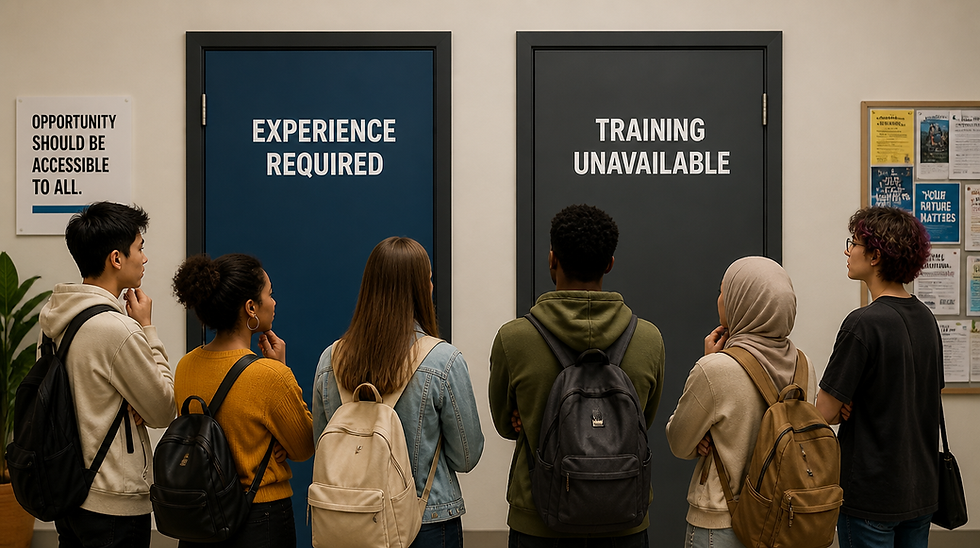
One of the most significant changes facing young adults is the disappearance of traditional entry-level employment.
Throughout much of the twentieth century, young people could enter the workforce through administrative jobs, retail management, customer service positions, factory work, and other roles that required little experience but offered opportunities for growth. These jobs provided income, workplace skills, professional networks, and a foundation for future advancement.
Many of those pathways have narrowed or disappeared.
Automation eliminated numerous routine jobs. Artificial intelligence is now beginning to reshape entry-level knowledge work. At the same time, employers increasingly expect candidates to possess experience before being hired, creating a paradox in which young people need experience to obtain work but need work to gain experience.
The growth of the gig economy has provided flexibility but often without meaningful training, progression, or long-term stability. For many young adults, the first rung of the career ladder has become considerably harder to reach.
The Rising Cost of Opportunity
Higher education has traditionally been presented as the solution to labor market uncertainty. Young people were encouraged to pursue degrees with the promise that education would unlock better prospects.
Degrees continue to provide value, but the economy has changed.
The cost of education has risen dramatically in many countries, while the salaries associated with some qualifications have become less predictable. Young people are investing more time and money in education than previous generations, often discovering that graduate-level opportunities are limited and highly competitive.
At the same time, housing costs have surged. Job openings increasingly cluster in major metropolitan areas where rent and living expenses consume a growing share of income. Moving to where opportunities exist is no longer a realistic option for many young adults.
As a result, growing numbers of young people remain financially dependent on parents for longer periods of time. While this arrangement may be economically rational, it often contributes to the feeling that traditional milestones of adulthood have been postponed indefinitely.
Mental Health and Economic Participation
Mental health has emerged as both a cause and consequence of youth disengagement.
Young adults across many developed countries report rising levels of anxiety, depression, stress, and burnout. Economic pressures contribute to these challenges. Housing insecurity, student debt, uncertain employment prospects, and social isolation all place significant strain on psychological well-being.
At the same time, mental health challenges can make it more difficult to complete education, maintain employment, participate in training, or sustain a prolonged job search.
The relationship is cyclical. Economic uncertainty affects mental health, and declining mental health makes economic participation more difficult. Once a young person begins moving away from education, employment, and social engagement, each additional step can make reentry more challenging.
The Cost of a Broken Social Contract

The consequences of rising NEET rates extend far beyond the individuals directly affected.
Families increasingly provide financial support to adult children who are unable to achieve independence. Governments face higher expenditures on health services, benefits, and social support programs. Employers lose access to talent, while economies lose productivity, innovation, tax revenue, and future growth.
Perhaps most importantly, society loses human potential.
Every young person who becomes disconnected from work, education, or training represents talents that remain undeveloped, contributions that go unrealized, and opportunities that are never fully explored.
Japan provides a cautionary example of what can happen when youth disengagement becomes entrenched. Decades of economic stagnation contributed to the emergence of large numbers of young people who withdrew from work, education, and social participation. The phenomenon became so widespread that it acquired its own name: hikikomori. What began as a labor market challenge evolved into a broader social issue affecting families, communities, and national productivity.
The lesson is clear. When large numbers of young people lose confidence in the pathways leading to adulthood and economic participation, the consequences can last for decades.
Rebuilding Opportunity
The encouraging news is that some countries have demonstrated that lower NEET rates are achievable.
Countries such as the Netherlands, Denmark, and Sweden have invested heavily in vocational education, apprenticeships, work-based learning, affordable childcare, active labor-market programs, and early intervention systems. These nations treat non-university pathways as respected and viable routes into adulthood rather than as secondary options for those who fail to attend university.
Their success suggests that youth disengagement is not inevitable.
When young people can see a realistic pathway from education to employment, when housing is attainable, when childcare enables workforce participation, and when support systems intervene before disengagement becomes entrenched, NEET rates fall, and economic participation rises.
Takeaways
The growth of NEETs is not simply a workforce issue; it is evidence that the traditional social contract connecting education, effort, and opportunity is under strain. Many young people have done what society asked of them by studying hard, earning qualifications, and seeking employment, yet face barriers that previous generations encountered less frequently.
The rise of NEETs reminds us that strong economies depend not only on creating jobs but on creating credible pathways to adulthood, economic participation, and hope for the future. Rebuilding those pathways may be one of the most important challenges facing developed societies in the decades ahead.







.png)